Notes from the North - 1
I left Paris on Thursday 20th October, on a Eurostar from the Gare du Nord. The journey itself was perfectly normal. What made it different was that I had no return ticket. Earlier that same day I had signed the acte de vente on my flat and handed over my keys There would be no return journey, or not one like all the others of the past 15+ years.
Since that date I have set about making a new home for myself in Edinburgh, a city I know well. The job is far from done but Notes from the North will be one way of documenting the change, of taking stock and, crucially, of maintaining my links with some of the people I lived among throughout those extraordinarily rich Paris years.
Tourists may flock to the castle but the truly outstanding feature of Edinburgh lies to the north of the city. Nothing built by human hands comes close to the grandeur of Arthur’s Seat and the Salisbury Crags.


The whole of Holyrood Park surrounding those two heights is a walker’s paradise and a geological treasure trove but one feature in particular deserves a mention: Hutton’s Section, a modest sill of rock low down on the Salisbury Crags. To the non-expert it doesn’t look anything special but it is a critical piece in the geological jigsaw of the area. The sill is a protrusion of magma which forced its way through older sedimentary rock millions of years ago.
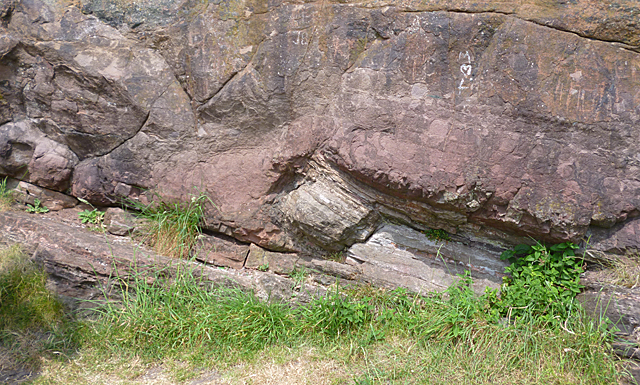
It is named after James Hutton, sometimes called the father of modern geology. Hutton’s Section is significant because it – and many other places which Hutton also investigated up and down Scotland – provides hard evidence of the ever-changing nature of the earth’s crust. This may no longer be a revolutionary idea but in the 18th century it was. One way to find out more about the geology of the city is by visiting Dynamic Earth, at the foot of the Royal Milne near the Scottish Parliament.
There is no metro in Edinburgh but there are plenty of buses and a single tramway that cost a fortune to build but now trundles back and forth between the airport and St Andrews Square. In the centre of that square stands a column at the top of which stands the statue of Henry Dundas, a contemporary of Hutton but a much more powerful political figure. He is best known these days for having delayed the abolition of the slave trade, thereby causing another half million Africans to be forced into slavery in the British colonies before 1833 (the year the Slave Trade Act was passed). Standing 40 metres above the ground on its plinth the Dundas statue is probably not going to meet the same inglorious end as Bristol’s Edward Colston, a direct beneficiary of the slave trade which Dundas was not. Still, in the long run the proposed new plaque telling ‘the real story’ of his role may not be enough to keep him up there, intact, inviolate.

The last time I was in St Andrew’s Square COP27 was on in Egypt. There were banners everywhere - environmentalists on one side and a group of striking railway workers from the RMT union on the other.

On 23rd November, the Supreme Court delivers its verdict on the question of whether the Scottish Nationalists, the main party in Scotland, can hold a referendum on independence next year without the consent of the government in Westminster. The court’s answer is unequivocal and unanimous – ‘no, they can’t.’ The verdict is welcomed rapturously in the House of Commons where the Prime Minister makes light of the dishonesty it depends on: that the United Kingdom is ‘a voluntary union of equals’. A pro-independence demonstration is taking place at Holyrood in expectation of the court's judgement. I walk there as the evening draws in. By the time I arrive there’s a good crowd, music – the Proclaimers of course - and plenty of flags and placards. On the far side of the road is a much smaller group of committed Unionists shouting as loud as they can but not loud enough to drown out the voice of Nicola Sturgeon, Scotland’s First Minister. She opens the evening with a passionate call for self-determination. Fight to protect democracy in Scotland! Rejoin the 'European family' which Scotland never voted to leave! Treat the next election as a de facto referendum on independence! Predictably the crowd loves it all.

I stay long enough to hear that there are similar gatherings in five European cities – Rome, Paris, Brussels, Berlin and Munich - and in fourteen other Scottish towns and cities. By the time I leave there’s a chill wind blowing. The road is dark – there are no street lights in the park. Jupiter is shining bright over the black hump of the hill. The swans float like ghosts on the loch. I’m thinking how loudly the crowd sang the great poet Hamish Henderson’s ‘Freedom, Come all Ye. Perhaps there's fire in the old volcano yet.

‘Roch the win i the clear day’s dawn Rough the wind in the clear day’s dawning
Blaws the clouds heilster-gowdie owre the bay Blowing the clouds billowing over the bay
But there’s mair nor a roch win blawin But there’s more than a rough wind blowing
Thro’ the Great Glen o’ the warl the day... Through the great valleys of the world today...


Comments
Post a Comment